“to feel time stretch and the body expand” – An interview with Tony Wagner
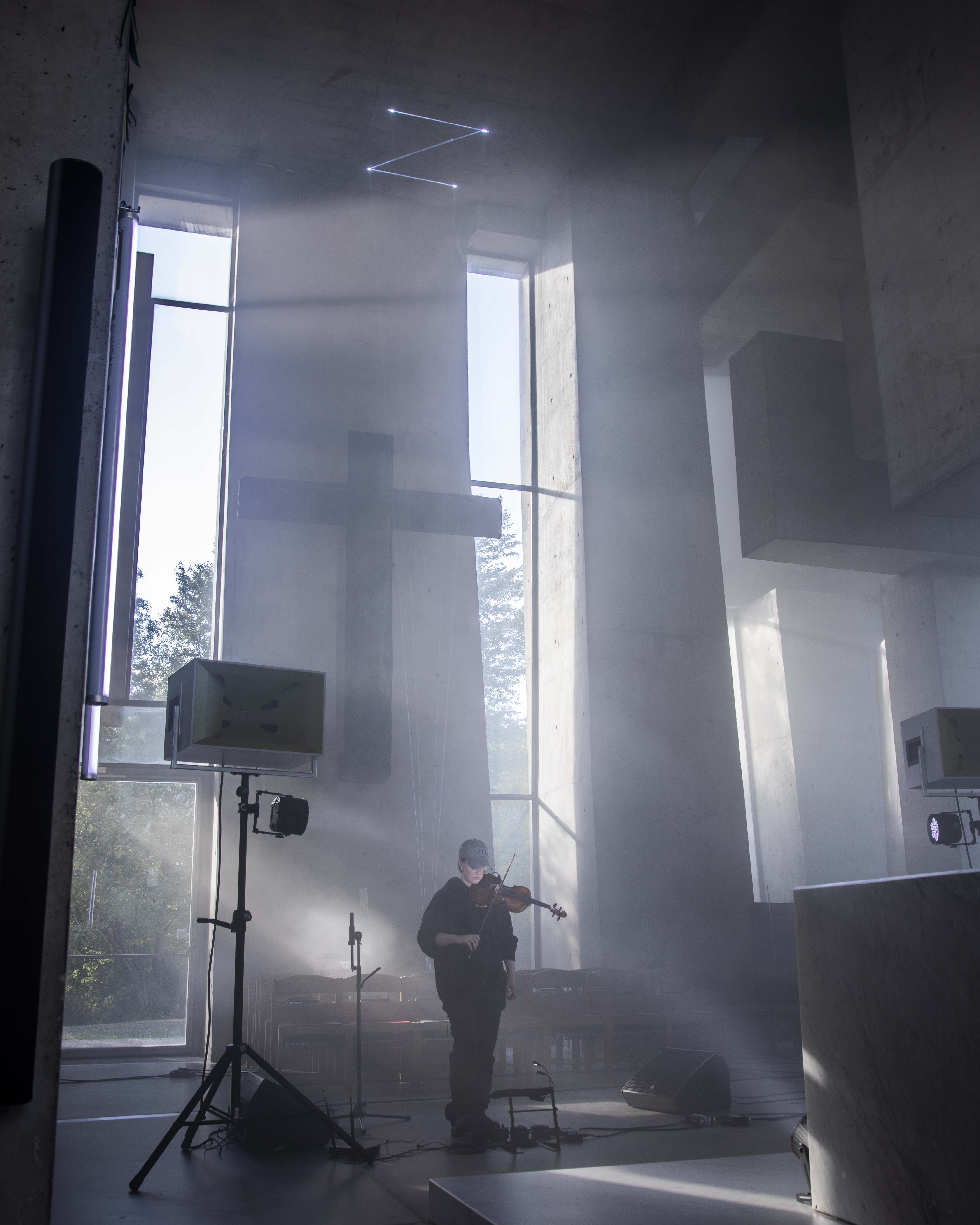
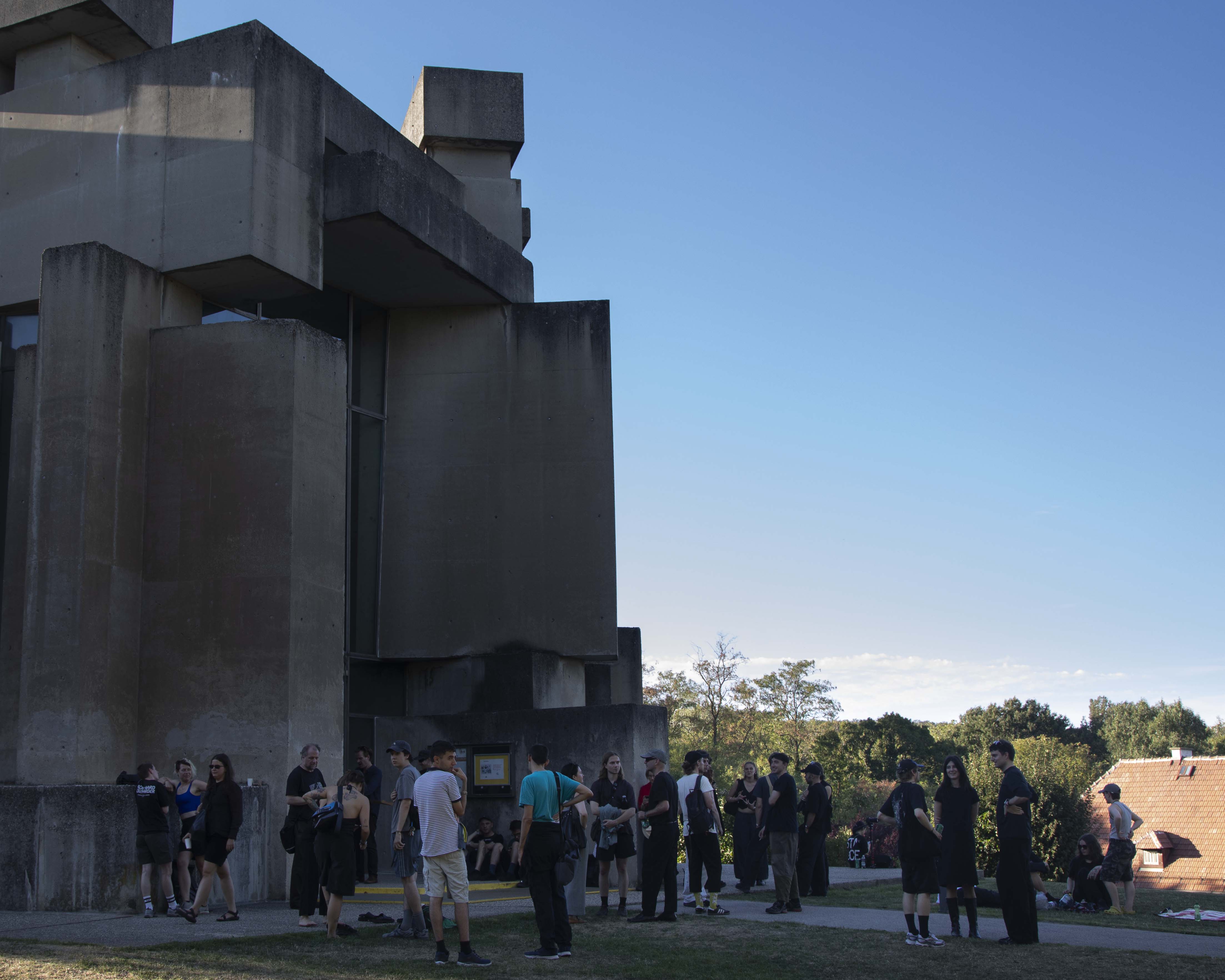
Hi Tony, let’s discuss your commissioned piece for Unsafe+Sounds Festival this year. It’s called Clustertract/Luxxx and is a site-specific composition for Wotruba Church. The church itself is an example of brutalist architecture. It’s a concrete building in the middle of nature at the outskirts of Vienna. How did you approach the piece? Inhowfar is it site-specific and how did the architecture of this sacred space influence the outcome?
Hi Shilla, thank you for your questions. The resonant space I am performing in is an integral part of how I approach a composition. I treat the architecture as a co-composer, a collaborating instrument, and also as a base for the score I’m writing. In the case of Wotruba Church I was interested in the irregular organization of the massive concrete blocks and the breaking of the conventionally holy arrangement. Layering staff lines and musical notes over this structure and mapping my steps as they lead through that constructed organ was fundamental to the work. I made the conscious decision for the space to influence the composition, so the drawing of the score came before the decision of which notes to play. I always leave space for improvisation. That way, the space stays unpredictable, like an expanding and contracting respiratory tract.
Your press text states that CLUSTERTRACT / LUXXX is partly a cultural-historical reflection on the violin as an instrument of community. What links the violin to forms of community, of coming together?
The answer might simply be: the devil. In Europe, roughly between the 16th and 18th centuries, the church deemed the violin the instrument of the devil because of its mobile and socially transgressive nature. It’s an instrument that can be played while walking, dancing and moving at gatherings, like dance floors outside the church’s walls. There, people could form their own ideas and organize beyond the church’s control. So the violin played a role as an enabler for people to gather and self-organize, which is a theme my pieces are grounded in.
Today, the violin is a rather romantic, classical instrument, often associated with virtuoso players and expensive instruments. You’re stretching and transgressing this conventional, normative image of the violin, and you offer us a sonic world that is immersive yet confrontational. The listening experience is different from following a beautiful melody or classical playing: it becomes abstract and physically affecting. It’s much more about intensities than about nice harmonies. What interests you about sound as affect?
I have a very long and ambivalent relationship with this instrument, and I had to take a long break from it until I came to understand that its possibilities were actually not as narrow as I had thought when I was growing up playing classical music. It has immense potential for testing out intensities and pushing emotional and physical boundaries. Paganini was even called the Devil’s Violinist for transgressing physical boundaries and conventional playing techniques. I love the immersive and cathartic effect of harmony in music, but I also love putting my finger on what hurts, disrupts, grinds and rubs, on what isn’t considered conventionally beautiful, because I see the potential for change in these spots.
“I have a very long and ambivalent relationship with this instrument”
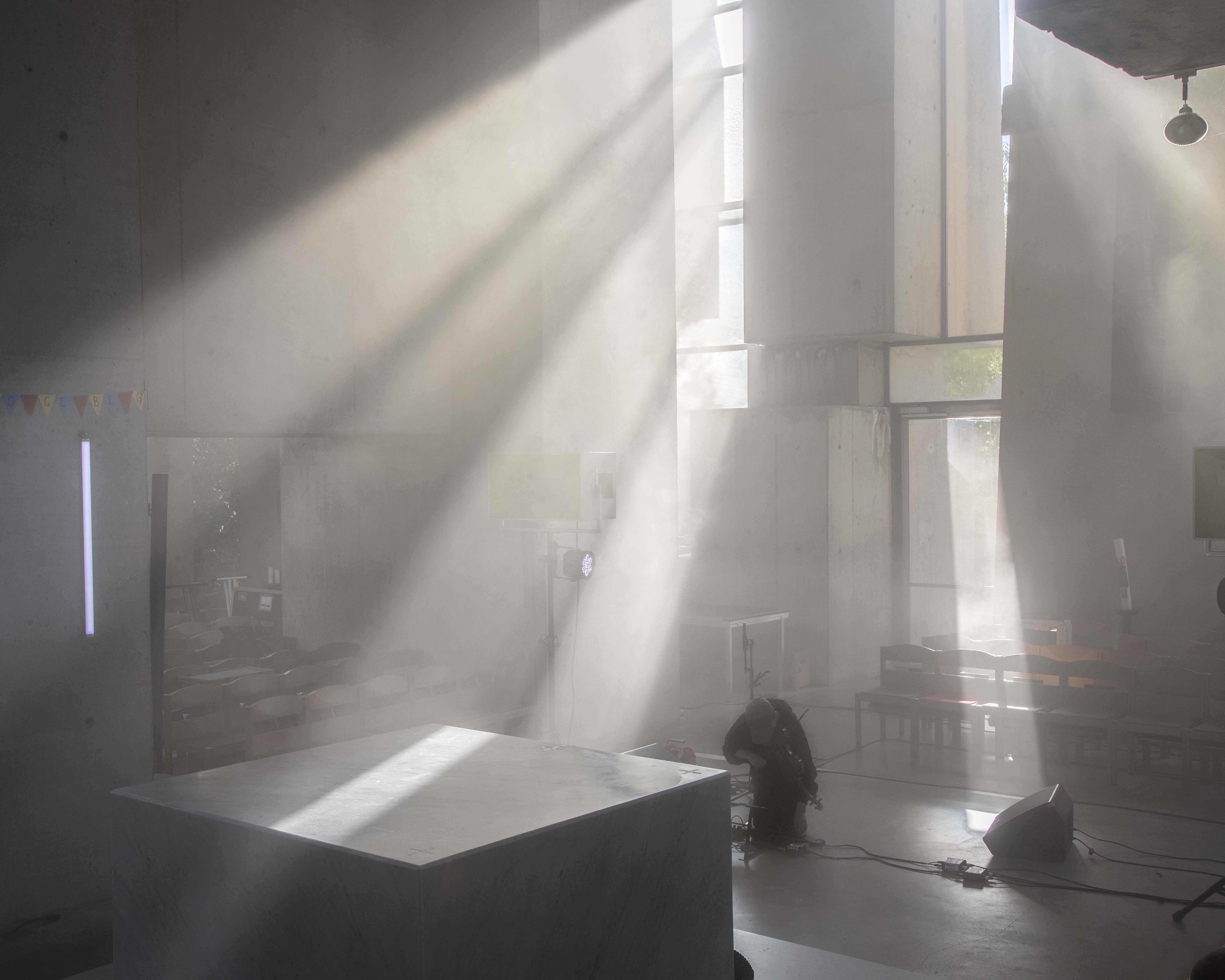
With your violin drones, you connect directly to the work of early minimalists like the violinist Tony Conrad, who was a collaborator of La Monte Young. What draws you personally to minimalism? Which strategies and experiments in your own work refer to the early minimalists?
Minimalism is actually an interesting word to describe the kind of music you’re mentioning. Even in the single drones that Conrad and Young’s ensemble used to play for hours, so many things happen, sonically and psychologically. I like to pay attention to subtle shifts, to see the space transform, to feel time stretch and the body expand (the body of an instrument and of organic matter). A lot happens when you decelerate and lean into a deeper focus on subtle shifts. I use tools like tone clusters, microtonal inflection, infinite sustain and difference tones to enter that space for experimentation. Difference tones are also called Tartini tones, by the way, after the violinist who wrote the “Devil’s Trill” sonata, to connect to that theme again.
Your work has strong psychoacoustic qualities. You evoke overtones and spectral tones; it’s more like you’re sculpting the sound, and you offer an experience that invites deep listening. You name Pauline Oliveros as an inspiration. Which parts of her philosophy of listening particularly speak to you?
I really admire Oliveros’ focus on the inclusivity of sound and its somatics: taking all sounds into consideration and treating them as equal parts of a composition. Just recently, the bassy buzzing of a helicopter became a wonderful collaborative instrument during a performance I did with the performer Veza Fernandez. Listening has become a flashy, almost esoteric buzzword, but I truly believe it’s important as a practice, not only in music but also politically, environmentally and socially. Pauline Oliveros’ practice is also a somatic one. The somatic quality of sound and listening is a strong connecting agent that shapes my practice, and it’s another place where I see potential for change.
“A lot happens when you decelerate and lean into a deeper focus on subtle shifts”
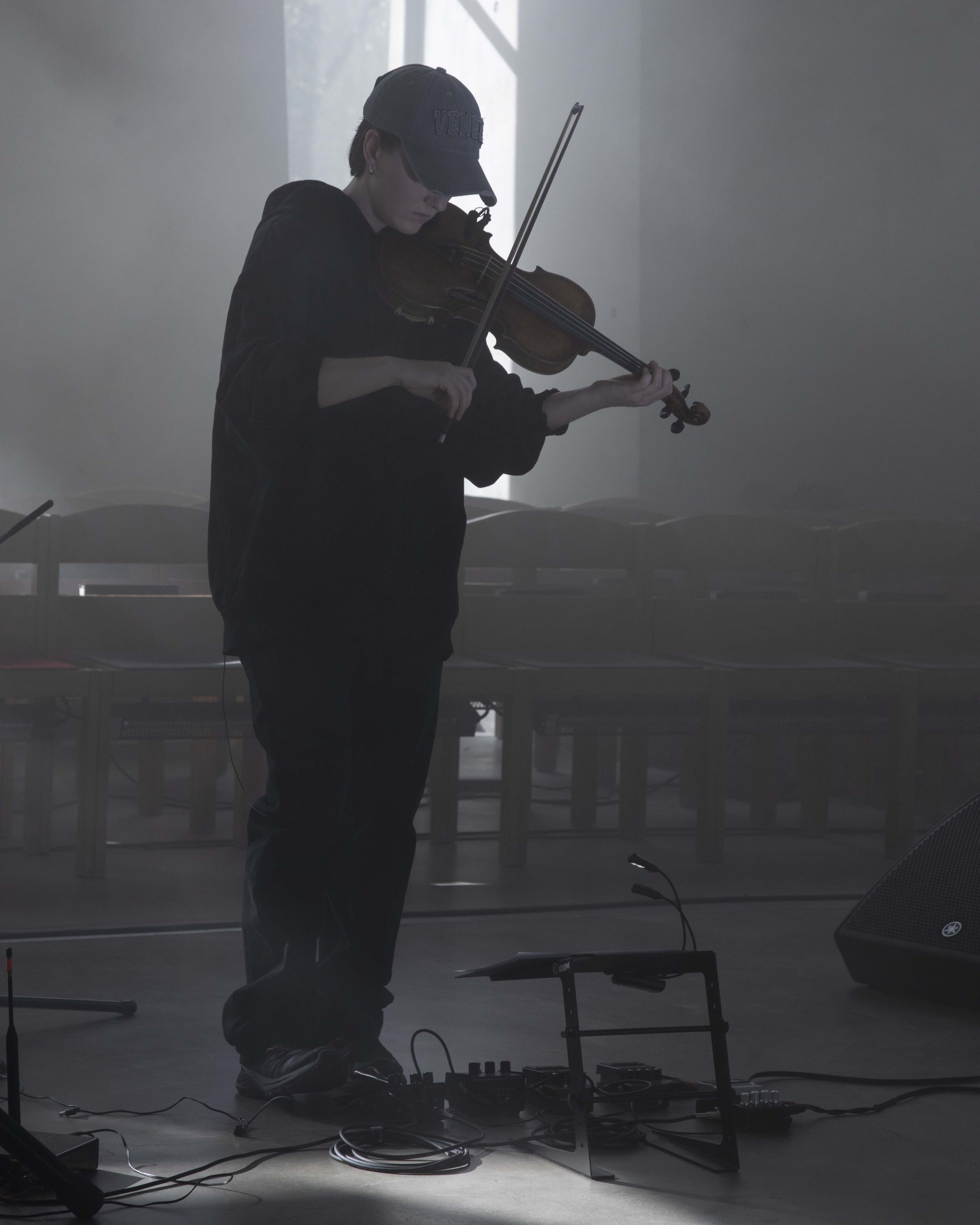
I’m always interested in the agency that sounds carry. Drone feels to me like such an elementary listening experience. It evokes listening inside a womb: the sound really wraps itself around your body, kind of embraces it, in a way that makes sound very tactile. How do you experience this effect while playing? Do you go really deep and immerse yourself, or are you very alert while performing? Or something in between?
The tactile aspect you’re talking about is one of the reasons why I think the best way to experience this kind of sound is in a site-specific setting. The space is a genuine co-composing actor that becomes an instrument itself. Inside and outside switch: I can shape the space with my instrument, but the space also shapes the sound, like an instrument. My own position is both. I’m simultaneously deeply immersed and highly aware; the immersion is a kind of awareness.
Is performing, for you, something like sharing the result of a sonic experiment with others, or is it more of an intimate moment, one that also speaks of personal expressivity? In other words, do you mainly want to share a listening experience with us, or do you also express a personal mood?
What I find most fascinating when I play these pieces is that performer, instrument, audience and space form a listening entity, like a single organism that self-organizes through focus. The performer–audience binary dissolves. The experiment happens together. We take part in a sonic experience and become this entity for a little while, an entity of focused attention, sensuality and sensitivity that open and expand. Of course there’s personal expression in it, but it’s expressed through the shared act.
“The performer–audience binary dissolves”
Your score looks exciting. Could you describe what it shows?
The score is a poetic mapping of the space: the blueprint of the Wotruba Church with its brutalist, irregular concrete shapes; my trajectories, the paths I walk; the notes I play; and the staff lines. I become part of the score myself, as do the architecture and the audience. Spatiality, composition and map in one. A score as a map, a map as a score.
Finally, the press text says that the composition also offers a contemporary perspective on shared experiences of loss. What do you mean by that?
The approach to shared grief is a somatic one. Even if we might not know each other well, we form a temporary community through the context of sound. Slowing down, focused listening and immersion in sound can create a foundation for shared support. Somatic practice can help us cope with our daily losses. The disconnect between mind and body in the contemporary world is profound, and I think sound can act as a bridge. An arc, a dot, a line, a map, to connect and dissolve.
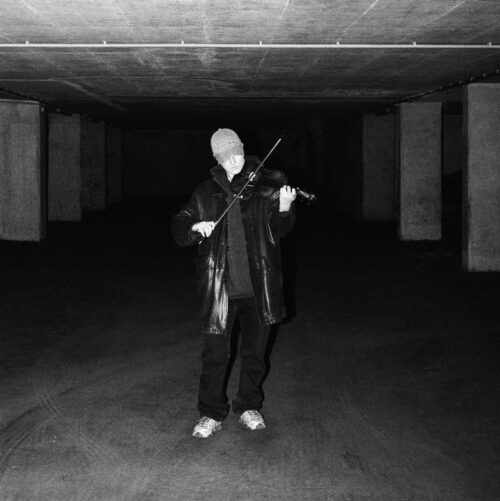
Tony Wagner